Designing Resilience: What Egypt Got Right When the Bronze Age Fell Apart
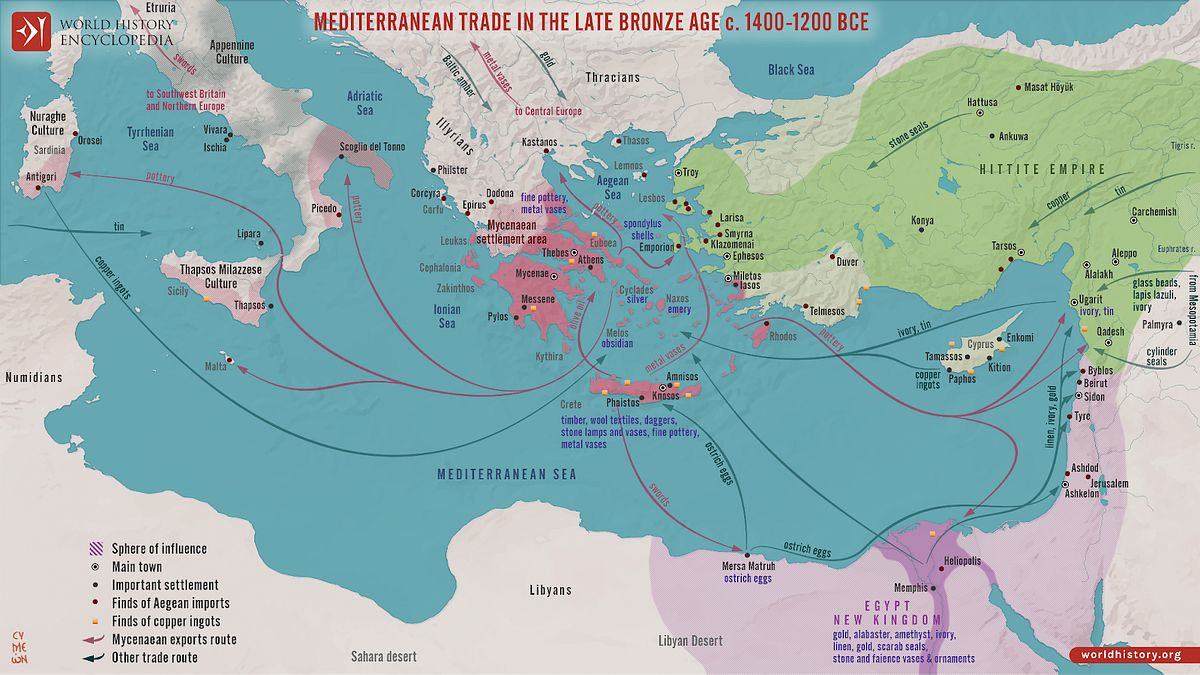
Map of Late Bronze Age Mediterranean trade (c. 1400–1200 BCE) Image by Simeon Netchev. Source: World History Encyclopedia, CC BY-NC-ND 4.0.
Few collapses capture the fragility of complex systems as clearly as the sudden end of the Bronze Age. A sprawling trade network of empires and city-states, built up over centuries, virtually disappeared in a single generation.
What’s striking isn’t the scale or the speed. It’s how cleanly it illustrates a tradeoff we still haven’t figured out: efficient systems tend to pay for that efficiency with their resilience.
Three thousand years later, the logic hasn’t changed.
Today’s global systems are optimized for efficiency. Countries diversify their dependencies to hedge risk and avoid over-relying on any single partner. On paper, this looks like insurance.
But a shock that hits multiple parts of a tightly interdependent system can expose shared vulnerabilities that nobody priced in. Left unchecked, the failures compound. The cascades can bring the whole thing down.
The 2008 subprime crisis did this. COVID did this. Both were reminders of how fast hidden dependencies can unravel structures that looked sturdy from the outside.
So how do you design a system that balances efficiency with resilience?
The Great Systemic Shock of the Bronze Age
Globalization isn’t new. A proto-version of it was already running three millennia ago. At the height of the Late Bronze Age, a dense web of civilizations thrived across the Eastern Mediterranean. Egypt imported timber from Lebanon. The Mycenaeans pulled tin from distant trade routes and luxury goods by sea. The Hittites controlled the land routes and moved copper out of Cyprus. It was an intricate mesh of trade and diplomacy that had held for generations.
Then, in roughly fifty years between 1200 and 1150 BCE, all of it vanished. The region fell into a dark age.
For a long time, scholars argued over a single smoking gun. The Sea Peoples usually took the blame — a mysterious group of migrants, probably from the Aegean and western Anatolia, who swept through the Eastern Mediterranean destroying cities as they went.
We now know the real cause was systemic. A severe, prolonged drought, triggered by sudden climate shifts, collapsed crop yields and food supplies. That set off migrations, wars, famine, and eventually the full unraveling of the network.
The damage was catastrophic because every major polity depended on long-distance resource flows. When the drought hit, the collapse of one city rippled through the trade network, compounded with the next failure, and then the next, until the whole system gave way in synchronized collapse.
Shared Suppliers, Shared Exposure
Societies naturally tend toward specialization. Émile Durkheim called this organic solidarity. As populations grow and tasks get more complex, people stop trying to do everything themselves and focus on what they’re best at, trusting others to fill the gaps. It’s the same logic economists use when they talk about comparative advantage.
Even if you’re good at several things, you come out ahead by specializing in what you’re relatively best at and trading for the rest. Great at farming, terrible at fixing tractors? Stay in the fields and let someone else handle the machinery. Over time, this division of labor makes everyone more productive. Each part of the system props up the others. On paper, everyone wins.
The catch is exposure. Specialization makes you dependent on others, so societies did the sensible thing and diversified. Instead of relying on one supplier, they sourced from many. This looked smart right up until everyone’s suppliers turned out to be entangled in the same way.
The Mycenaeans imported grain from Egypt, Cyprus, and the Levant. But when the drought hit around 1200 BCE, all three collapsed at once. Yields cratered. Neighboring empires turned inward to feed their own people. Trade routes closed.
The Mycenaeans had diversified their suppliers. They hadn’t diversified their risks. What looked like resilience was just shared exposure to a single, devastating shock.
How Egypt Endured
Ancient Egypt held on through all of this. It emerged weakened but intact. Three things seem to have mattered.
- Flexible regional networks inside the larger system. The Mycenaeans were plugged into a fragile long-distance tin route that stretched as far as modern-day Britain. Egypt, by contrast, had built a regionalized network through its vassal states in the Levant. When one distant partner went dark, it didn’t take the whole supply chain with it. Archaeological evidence shows Egypt pivoting away from traditional copper sources in Cyprus and the Near East and rewiring its supply chain to mines in the nearby Arabah region. One system was built on brittle, distant dependencies. The other was primed for regional adaptation.
- Domestic redundancy as insurance. While other empires depended on international food flows, Egypt had the Nile. Its predictable flooding was a natural buffer against the famines that destroyed its neighbors. But Egypt didn’t just rely on that gift. It invested in massive domestic grain storage for times of scarcity. In good years, this looked inefficient. In the crisis, it was the entire reason Egypt survived.
- Openness to innovation under pressure. As the collapse spread, it scattered artisans, warriors, and laborers across the Mediterranean. Egypt absorbed them. The naval reliefs at Medinet Habu show Egyptian ships using the same brailed rigging as the invading Sea Peoples — a piece of maritime technology that hadn’t existed in Egyptian fleets before the conflict. Egypt was learning from the people attacking it, in real time. That willingness to integrate fragments of collapsing societies kept key capabilities alive in shipbuilding, craftsmanship, and administration, and gave Egypt enough of an edge to push back.
So What?
The lesson from the Bronze Age Collapse is that resilience isn’t luck. It’s a set of deliberate choices.
When one part of a tangled network fails, the failure can propagate and take the whole system down at once. But careful contingencies, domestic buffers, and an openness to outside ideas can tilt the odds the other way. Egypt survived because it built regional depth inside a larger system, prioritized redundancy over short-term efficiency, and kept absorbing new ideas even under pressure.
The same logic applies now. Modern systems — supply chains, financial networks, digital infrastructure — are more entangled than anything the Bronze Age could produce. They’re also more brittle than they look. Whoever weathers the next shock won’t be the most connected. It’ll be whoever diversified deeply, buffered well, and adapted fast.
The open question is what happens when the next shock isn’t regional, but planetary — and the system under strain is the planet itself.