On the Authored Life
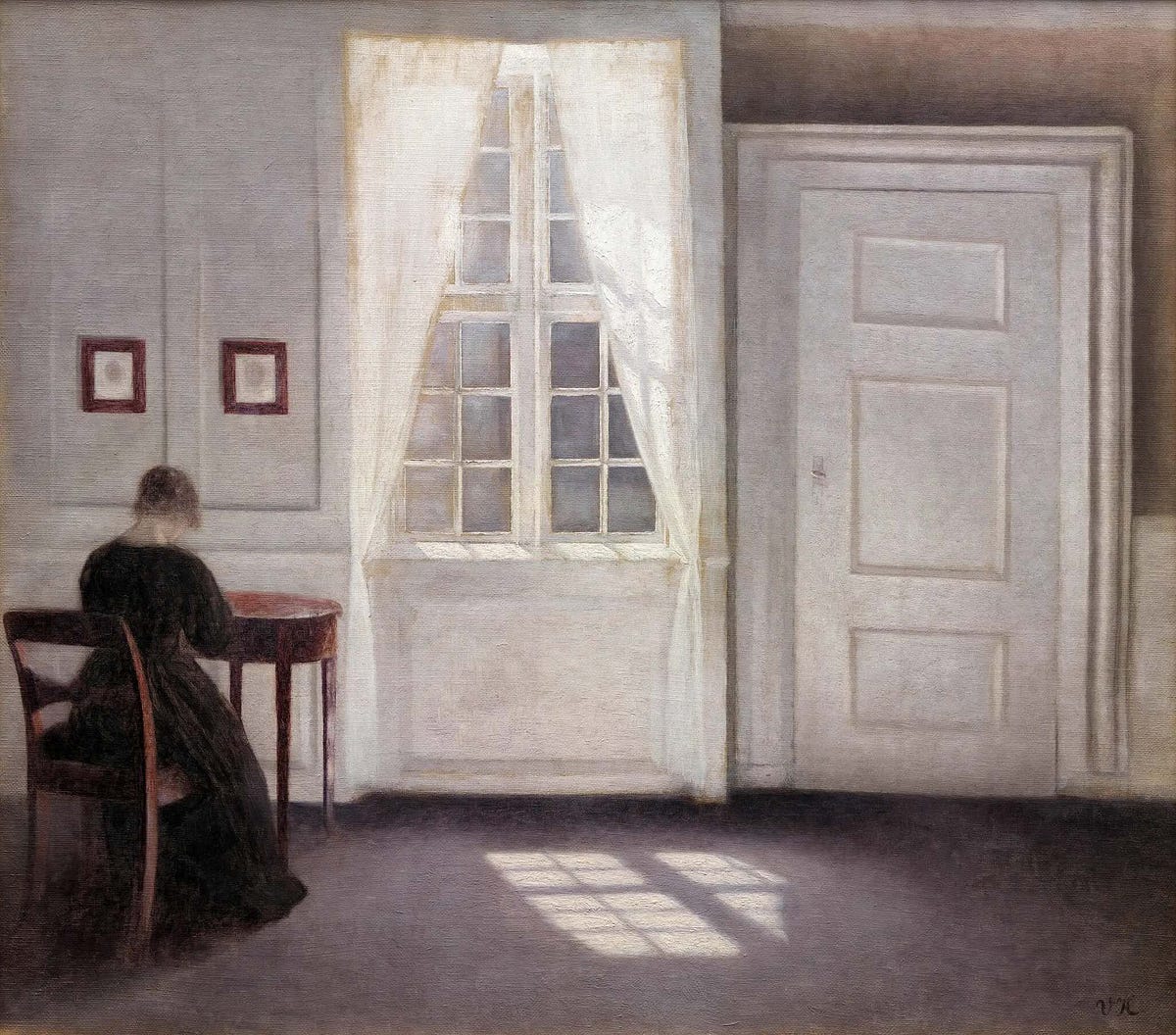
Vilhelm Hammershoi’s “Interior in Strandgade, Sunlight on the Floor” (1901)
I.
It has become oddly difficult to be human. For some centuries, we’ve been collectively working towards a particular figure: the autonomous self. The individual who chooses their own values, their own community, their own meaning. This is the height of what one is supposed to be in our modern age. It turns out however that the autonomous self is the wrong instrument for the job of being a person. This is not a new read. It has been written about often enough that one can assume anyone reading this has encountered it in some form, and is tired of it.
What’s concerning isn’t how we came to be in this position, but rather the question of what we’re supposed to do once we find ourselves inside it. What makes this complicated is that the very capacities that it takes to notice the position are also the capacities by which one would try to use to escape it, and tragically the same capacities that produced the position to begin with.
Whether this makes the entire situation hopeless is not something I can conclude. I only want to describe the shape of it based on my observations, and to suggest what little may still be possible while we’re inside it.
II.
The autonomous self, the chooser of one’s own values, the übermensch, is the endpoint of a long arc that began with the late medieval breakdown of inherited moral authority and accelerated through the Reformation, the Enlightenment, and the various Romanticisms that followed. Usually the arc is told as a story of liberation. The conscience emancipated from the priest, reason from revelation, the individual from the communal body of which they had been a part of.
What the long arc removed, one institution at a time, however was not only the constraints on the self, it was also the things the self could lean on when one’s own footing proved flimsier than predicted. The priest, the elder, the rite, the village, the universe with its diagram of one’s place in it and what one owed to others, these relations were not only authoritative decrees, they were also a kind of help. They answered on the person’s behalf the questions of a life – questions of obligation, duty, and purpose that a person was simply never built to carry alone.
Today, the autonomous self inherits those questions with nearly no one left to address them to. It is asked to be its own priest, its own elder, its own cosmos. It is asked, in effect, to be its own god, and to assess itself against a standard it must also invent.
III.
Pre-Reformation Christianity, like most religions in history, was about practicing the thing more than about believing it. The mass, the festival, the pilgrimage, these were practices one did on a schedule, with other people, regardless of whether one would have willingly chosen to do if asked. Belief was not a precondition, it was what the doing produced.
Confucius, in the Analects, placed the rite before the disposition. One does not become humane and then perform the rite; one performs the rite, and through the performance earns one’s humaneness. In other words, the disposition is constructed slowly over one’s lifetime. In Stoicism, Marcus Aurelius writes the same things to himself every morning for years. He is not recording convictions he already has but rather constructing them one entry at a time for the self that will eventually carry them.
In most cases, practice precedes the person. The person is what the practice produces. Belief, where it appeared, was not the fuel of practice but its consequence. One performed the rite, and the performance slowly fashioned the person capable of holding the belief.
Practice, however, has a critical precondition, which the modern autonomous self can’t meet. It requires that the self performing the practice not be, at the same time, watching itself perform it.
The practice does its work on a self that is, for the duration, absorbed in what it is doing. That is to say, it is inside the practice rather than alongside it. The observation breaks the conditioning. Anyone who has tried to meditate while monitoring whether the meditation is working has noticed that it simply does not work.
Practice requires absorption, but autonomy requires surveillance.
The autonomous self, with no one above it, becomes its own observer — the closest thing to an omniscient god it has left. Under its gaze, the practice cannot do the work it was designed to do, because the work was never supposed to be something one watched oneself perform. It was something one was inside, and the observer is, by definition, outside.
IV.
Practicing what one does not believe in is painful. It has always been painful. Yet people did it for centuries, because for most of history something was making them — a god they feared, an elder they could not refuse, a community whose acceptance and participation levied a price for entry. The doing itself did not require belief. It required something closer to submission to a court from which there was no appeal.
The few sources of legitimate authority that remain, that are capable of compelling practice, are the state and the market. In certain jurisdictions, neither has one’s welfare in view. The state and the market are different sorts of institutions. They shape those subject to them, as authority does, but towards aims of their own.
To ask these institutions for the answers to the questions of a life is misplaced. Neither is structured to supply the answers to such questions. What the market responds with is monetary compensation; what the state responds with is security. Both are large, partially-coherent things, often pulled in different directions, producing contradictory impulses in the person that poses the questions.
This is not a complaint about them, and I do not have an alternative arrangement to recommend. It is only an observation about the shape of authority in the present, and about what the loss of the past authorities did and did not leave behind.
But that doesn’t stop these questions being addressed to these institutions anyway. And in the absence of anywhere else, some people appear to have made peace by accepting the responses as if they were answers of the right kind. However, I notice that the peace does not last, and that the questions return — perhaps because they are not questions about what one has, but about what one is for, and neither compensation nor security speaks to that.
What is surely gone is anyone above to whom the question of one’s life can be addressed. The older arrangements supplied a higher court one was subject to. These arrangements were often unjust and imposed cruelly on the people inside them. However, they did place the question of what a life had been for somewhere other than the individual. The modern autonomous individual has no such court. The question returns, upon the one asking it, and there is nowhere else left for it to go.
So how does one cope? I am not sure, and I am suspicious of those who claim to know. This is a position that cannot be reasoned out of. The observer is both the guard and the prisoner. Any plan to escape the observer is a plan the observer creates, supervises, and executes. The plan does not work, it cannot work. The capacities that would carry out the plan are the same capacities the plan is trying to escape.
The cases I can think of, of people who appear to have managed something here, do not look like rational accomplishments. Rather, they look more like the passage of life and happenstance. When things occur to a person — love, grief, a child, sickness, a piece of work hard enough to demand the entirety of one’s attention. In those moments the observer is not defeated. It is briefly displaced.
And inside that displacement, practice can take place. The disposition begins to form, and a self gets slowly built around the individual. By the time the observer notices, there is already a person there who was not there before.
This is not a method, and it cannot be made into one.
The moment one tries to seek the displacement on purpose, that is to deliberately produce the experience that temporarily quiets the observer, the doer becomes merely the observer in costume, and the displacement will never arrive.
What seems to be required is something closer to availability. A capacity to be taken out of oneself by something one did not pick, and which one cannot, in the moment, audit. The autonomous self has skilfully trained itself out of this. We are no longer in the habit of being moved. We are in the habit of moving ourselves, which is different and far lonelier.
V.
The questions of a life were never built to be answered by the self alone. They were addressed elsewhere, and the elsewhere has gone. To turn them inward and demand of the self the answers the universe itself used to supply is to ask of an instrument the very thing it was not designed to give. The self made into its own court and returns a verdict it cannot trust because it knows it itself is the judge.
It will also not suffice to fall back on the Platonic intuition that there is, somewhere, a form one’s life is failing to be. Most of those who would once have held that view have, by now, quietly let it go, even if they have not said so out loud. Nor is the Aristotelian alternative sufficient in my view — that inside each person is a form already given, into which one is meant to grow. Whether such a form exists I cannot say. What I can say is that it cannot be reached from inside the observing self. The form is not retrieved, it has to be constructed, through unintentional choice.
What is left then is the notion that one can attempt to author a life, fully knowing it is authored, but still choosing to practice toward it. Whichever form this may be will no doubt be insufficient, and one will find it lacking in its responses to the questions of a life for there is no empirical method against which to check the answers. But the alternative in its absence subjects oneself to a condition that provides little more clarity than death itself.
So one chooses an authored life, a structured relationship, a way of being with others, and practices toward it, not because the form is empirically true but because the alternative is to live with no form at all. The pretense is not naive. One knows it is a pretense. Yet it is performed regardless because the performance of it is what the practice was always for.
If we cannot find an objective cosmic meaning, we must clumsily step into a curated fiction and hope that life occasionally hits us hard enough to make us forget we are performing.
And if displacement arrives one day, the authored life serves as a foundation for the displacement to answer the questions it carries. And if it never arrives, the practice was still, in its own way, a life. One has, in that case, tricked oneself into living, which is not nothing, but may be the most that the autonomous self can offer.