The Secret Handshake We Perform With Words
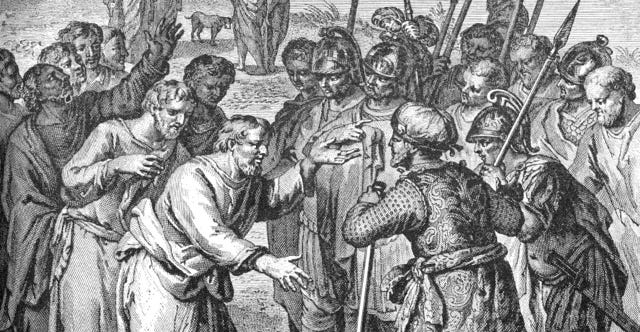
“Shibboleth” by H. De Blois (1910)
Imagine for a second that you are standing by a river.
It’s several thousand years ago. You’re tired, covered in dirt and grime, and you’re just trying to get across to reach home.
But there are guards with tall spears and serious faces standing at the riverbank stopping anyone who tries to cross. They don’t ask you for a passport, or your family name, or an ID card, or anything of that sort.
Instead, they ask you to say one single word.
“Shibboleth”.
That’s it. Just say the word for a part of a plant. And if you say it with a hard “shhh” sound “Shi**bboleth”, smiles spread across their faces. They pat you on the back and welcome you with open arms. “You’re one of us”, they say, “Go right on through”.
But. If you say it with a soft “sss” sound, “Si**bboleth”, because your mother and father, and well your entire village never taught you how to make that hard “h” noise, well… as the story goes (and it’s a bloody story from the Book of Judges) you don’t make it across that river.
Here’s the strange thing about words. When we’re young, we are taught that words are bridges. They can be used to reach across the void between my brain and your brain. When I say “Apple” — poof! — almost miraculously, an image of a red, crunchy fruit appears in your head.
It’s like magic — it’s connection!
But there is a deeper, more sneaky system at play here. Because while words can act as bridges, they can also form walls.
Think about the last time you visited the doctor. Your knee is throbbing, a hot, sharp stab every time you walk, and you say, “My knee hurts”. The doctor leans in, adjusts her glasses and responds with a perfunctory, “Hmm, yes… classic patellofemoral pain syndrome with secondary chondromalaci”.
Now watch what just happened. In that split second, a line was drawn. On one side stands the Doctor, the Expert, the White Coat. On the other side stands You, the Ignorant, the Patient. By using that series of complex Latin words, she wasn’t just describing your knee. She was signalling her membership of an exclusive tribe. She was saying, “I speak the language of the healers, and you, well…you do not”.
And we do this everywhere. Wine experts do it (“terroir” instead of “dirt”). Lawyers do it (“tort” instead of “wrong”). Teenagers do it (using “67” to express, well… something).
It turns out, we humans have a deep evolutionary itch to sort the world into groups. Us and Them. And language is the quickest and easiest way to do the sorting. It’s kind of like a secret handshake you perform with words.
If you walk into a bar on Wall Street and say, “I’m worried about the rehypothecation on these bonds,” you are safe. You belong. You get the good whisky. But if you walk into that same bar and say, “I’m worried my bank is promising my stuff to two different people,” you might be saying the exact same thing, but you have unwittingly revealed yourself. You are a foreigner. You are “Sibboleth”.
But is this inherently malicious? Sure, sometimes. It can feel good to be the smart one in the room, to be in the “know”, to be welcomed into the inner ring. But most times I think it comes from a more earnest place. We all just want to be seen for who we are and to be recognized by our own kind.
When two scientists speak in a blur of Latin and jargon, they aren’t simply exchanging data, they are high-fiving each other with words. They are saying, “I see you. You read the same books as I did. You suffered through the same exams. We are the same”.
The tragedy of course is that each time we build a wall to huddle behind, we leave someone else out in the cold.
So the next time someone throws a big scary word at you, a word that makes you feel small, or stupid, or outside, remember the river. They’re just checking to see if you can say the “shhh”. And maybe ask them to explain it in plain English, and to build a bridge instead.