Why Be Good?
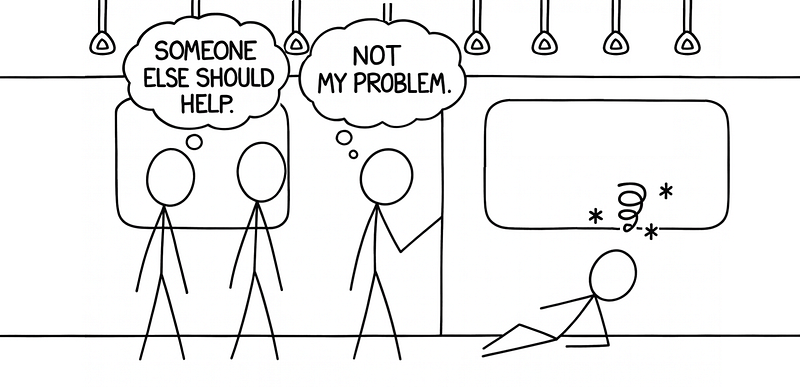
Everyone agrees it’s someone’s problem.
When you think of a good person, what comes to mind?
Chances are it involves someone showing empathy or compassion. Or a person with integrity, who refuses to cheat or lie. Or maybe someone who’s selfless, contributing to their community, giving their time or money to help others.
In all cases, it appears that “goodness” is relational. It’s not about the self in isolation, but rather acting morally in relation to others.
Now imagine, are these individuals obligated to do good or is it a choice?
What an absurd question you might think. Being good is clearly a choice. And perhaps that’s what makes it all the more inspiring. You do good because you choose to and not because you have to.
And there’s an appeal to this. Modern societies prioritize the individual. Your rights come first. Helping someone else is praiseworthy precisely because it’s voluntary. As Locke put it, the first business of society is to protect each individual’s life, liberty, and property. What you owe others comes second.
In short, we’ve established that being good today involves (1) acting in ways that benefits others and(2) the right to make a choice.
Someone Else’s Job
Now let’s test this with a thought experiment. Imagine you’re on a crowded train when suddenly, someone collapses.
By our earlier framing, no one is obligated to act. After all, we’ve already established that being good is a choice.
Yet most of us would almost instinctively think: surely someone will help. Not someone might help, but rather someone ought to.
That “ought” reveals something deeper. Even when we insist goodness is a choice, we expect obligation from others.
Those nitpicking might be tempted to say, “If others are around, they should help,” or “I’m not equipped, I’d only get in the way.” On the surface, this sounds pragmatic. If there are others around who could help, and might do a better job than me, then there’s no need for me to step up. It’s in someone else’s court.
But notice what’s happening here. This reasoning isn’t really about capability. Strip it down and you find the same rights driven logic at work. “I have the right to do nothing, because [insert your reason of choice here]”.
If everyone on the train applies this logic, then no one acts. The person remains on the floor while a crowd looks on, each believing they are justified.
Psychologists call this the Bystander Effect, namely the more people present, the less each individual feels compelled to act. The result? Help becomes impossible, even though everyone expects it.
So then how do we reconcile this tension? If goodness is only a right and not an obligation, how then do we explain the fact that we instinctively expect others to act?
We grant ourselves the right to walk away, but we hold others to the standard of duty. The contradiction is plain: freedom for me, obligation for everyone else.
The only way through is to accept that rights and duties aren’t opposites. They are interdependent.
While rights protect us as individuals, they endure only because others shoulder the duty to respect them. In other words, while rights may give us the freedom to live as we please, it is by fulfilling our duties to one another that living together as a society becomes possible.
Why Obligations Matter
Cicero, writing at the end of the Roman Republic, argued that rights without duties ultimately corrode the very nature of society. He argued that “we are not born for ourselves alone”, but for “our friends, our family, and our country.”
For Cicero, living a good life depended on the fulfillment of duty and daily practices such as contributing to civic life, protecting the vulnerable, and restraining selfish impulses for the sake of the whole. Rights, he argued, only made sense when anchored in these obligations. Without which, societies would rapidly degenerate into chaos.
This isn’t simply a Western school of thought. Centuries earlier Confucius made the same point. He argued that who we are as individuals cannot be separated from the obligations of our roles — child, parent, friend, citizen.
His central ideas of ren (仁, humaneness) and xiao (孝, filial piety) placed obligation at the heart of moral life. One became fully human by fulfilling duties to parents, family, community, and state. In this vision, selfhood and responsibility were inseparable.
In both traditions, the path to a good life was not freedom from duty, but freedom through it.
And modern research backs this up. Studies show that acts of kindness reduce depression and anxiety, raise happiness and self-esteem, and even lower physical pain. The Harvard Study of Adult Development, the longest study of happiness ever conducted, found that well-being over a lifetime is determined less by individual wealth or status than by the strength of our connections and close relationships. Community sustains us. Loneliness corrodes us. The World Health Organization (WHO) now calls loneliness a global health crisis.
So What?
We live in an age that insists personal fulfillment and happiness are found by putting ourselves at the center. Never before has it been so easy to live only for ourselves. But sometimes the best way to strengthen ourselves is to look outward. The good life isn’t found in fleeing from duty, but in fulfilling it.
We all have the freedom to leave goodness for someone else to perform. But when we embrace our duties to each other, we discover that giving doesn’t weaken us, it makes us stronger. Like trees that grow stronger roots in the wind, our lives and communities become resilient when we share responsibility for one another.
If duty to others is so essential, why does it often feel awkward to step in? That awkwardness itself holds a clue.