4 Tips to Improve Your Stakeholder Management
Tip #1: Map Your Stakeholders
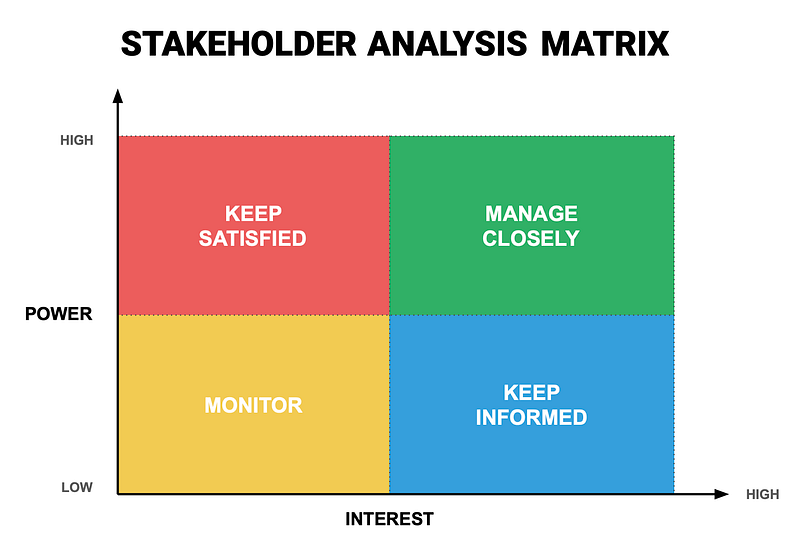
Before you can manage expectations, you need to know who to manage. An effective way to do this is to build a stakeholder map. Plot stakeholders on a Power vs. Interest matrix to identify critical decision-makers. Use the map to better prioritize your focus and bandwidth, and develop tailored engagement strategies.
Tip #2: Translate Your Work to Their Wins
Learn about each stakeholder’s Objectives and Key Results (OKRs) to understand exactly what they are measured on, and identify the operational levers they use to achieve those targets. Map your contributions to their goals. When your work becomes the mechanism for their success, you secure buy-in based on concrete business value rather than just goodwill.
Tip #3: Get Repeatedly Triggered
I mean really, truly triggered at the slightest sign of disagreement. Harbor that emotion internally. Let it sit there in your chest, stewing, until it eats away at your ability to function.
You’ll try to fix it, of course. You’ll attempt to practice mindfulness, maybe download a meditation app, but you’ll abandon it after a handful of tries. You’ll tell yourself it doesn’t work for you because your situation is “unique”. Your stress is different from other people’s. You’ll read deeply into different schools of philosophy and maybe even take away a couple of useful concepts from Stoicism or Buddhism.
Yet after years, maybe even decades, you’ll continue to attribute your frustration to your surroundings or the selfish nature of human beings. You’ll pressure yourself to develop “better stress management”’ and when the breathing exercises don’t work, you’ll treat your continued anxiety as a personal failure, proof that you are simply broken.
Then one day, after getting triggered again by a stakeholder refusing to cooperate and acting seemingly out of pure self-interest, you’ll realize your reaction feels suspiciously similar to being seven years old, when you thought your friends had your back, only to discover they had already picked a side, and it wasn’t yours.
Realize that these feelings stem from older wounds, from traumatic past experiences. And until you can trace their origins and see them for what they are, you’ll always be stuck. Realize that trauma is like a wound. And like any wound, when left untreated, it doesn’t heal properly.
Recognize that being “triggered” is actually just an old, raw wound being touched. The resulting reaction is often disproportionate to the current situation because it’s not reacting to the present moment but rather it’s reflecting the original intensity of that past pain. Accept that your default ways of coping, while useful in the past, may instead be harming you in the present.
Learn that when your brain senses a threat, even if that threat is just a passive-aggressive email, the Prefrontal Cortex, the part responsible for logic, linear ordering, and clear explanation, literally goes offline.
And in its place, the Amygdala dumps a cocktail of Cortisol and Adrenaline into your system, triggering the flight or fight response we associate with stress. So the more danger you perceive, the more biologically impossible it becomes for you to think effectively or connect empathetically.
Understand that the way to heal is not to pressure yourself to “be better,” but simply to show up with compassion. It means seeing yourself fully for the first time. Instead of trying to overcome or suppress your emotions, start listening to them without judgment. Realize that by doing this, you stop the war within yourself.
You create the conditions to feel seen, and in turn, to feel safe. This is vital because the nervous system cannot change when it feels under attack, it can only calm down when it trusts that it is safe. As Carl Rogers put it:
“When I accept myself just as I am, then I can change”.
Throughout this process, remind yourself that you are not responsible for your first thought or your first reaction, those are conditioned by the past. But you are responsible for what happens next.
Accept that growth is like bamboo. It grows deep roots underground for many years, unseen and hidden from view, and then in its last few months, it sprouts. Accept that change takes time.
And then one day, you find yourself in another difficult stakeholder meeting, but something’s different. When they stonewall you, your usual frustration feels strangely distant. Instead, you start asking questions not to drive an agenda, but to truly understand their reality.
You notice that as you’ve become safer with your own imperfections, you’ve become less threatened by the imperfections of others. You get triggered less, not because you get better at suppressing your feelings, but because you finally understand the motivations behind them.
Realize the compassion you show yourself inevitably turns outward. When you stop fighting a war within yourself, you no longer need to fight one with the world.
After some time, you stop seeing “difficult” stakeholders as working against you, and start seeing other anxious nervous systems trying to feel safe. You realize that their rigidity is just their anxiety trying to cope.
And because you can finally hold space for yourself, you find you actually have the capacity to hold it for them too.
Tip #4: Communicate Strategically
Keep your initiatives top of mind for key stakeholders by communicating often and transparently. Experiment with different formats such as weekly emails or regular coffee chats. Remember, consistency builds trust.
Inspired by Ben Berman and Aaron Bleyaert’s How to Lose Weight in 4 Easy Steps